


Cost to Add a Second Story in Contra Costa County: 2026 Price Guide

Moving to a larger home in Walnut Creek or Lafayette has become a million-dollar decision that many homeowners are choosing to avoid in 2026. You likely recognize that your current neighborhood is irreplaceable, yet your existing floor plan no longer supports your family's lifestyle. It's common to feel a sense of hesitation when considering the cost to add a second story Contra Costa County projects require, especially with concerns regarding seismic safety and the logistics of long-term construction. We understand that protecting your investment requires more than just bricks and mortar; it requires a disciplined partnership built on integrity.
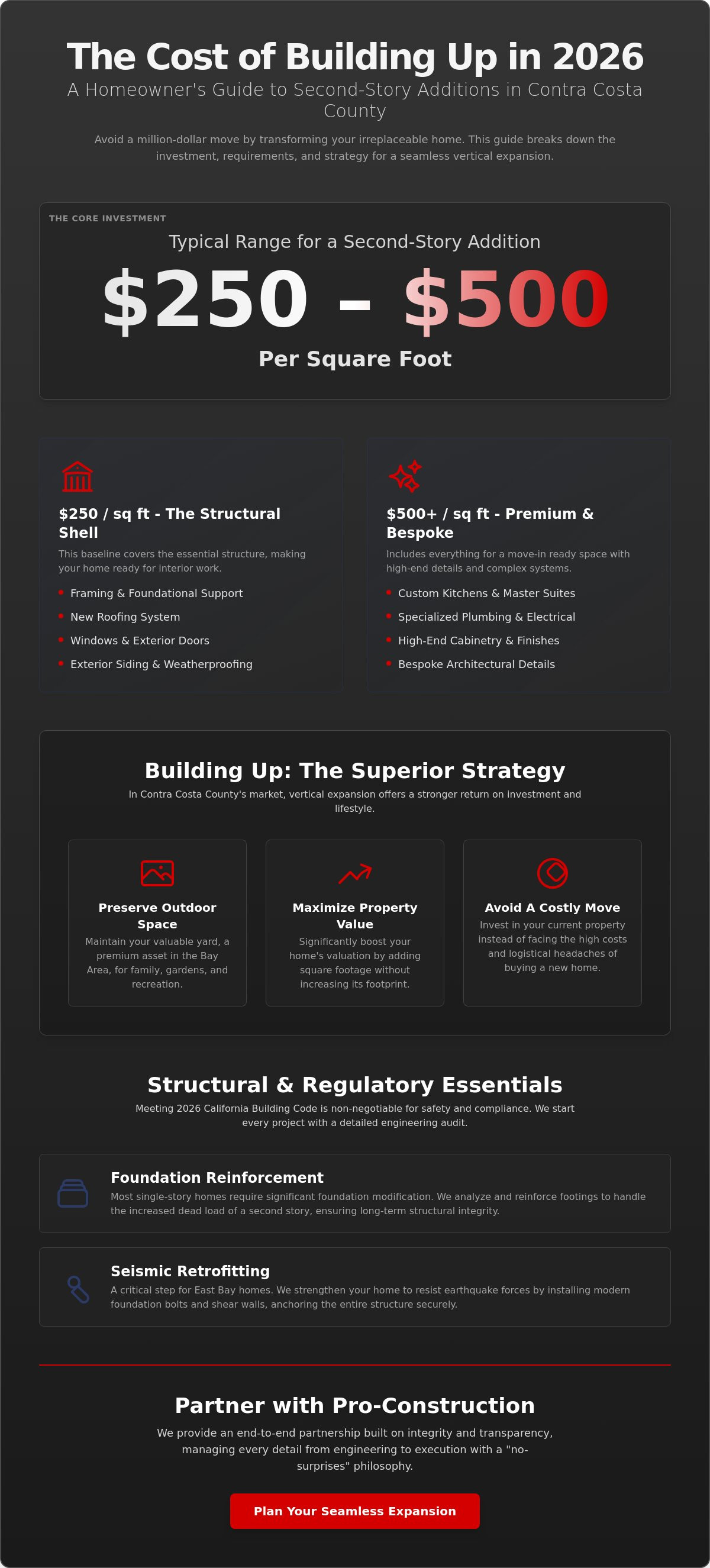
We've designed this guide to offer the professional oversight and clarity you deserve before breaking ground. You'll find a comprehensive breakdown of the $250 to $500 per square foot investment range and the specific structural mandates unique to our region. We'll also examine the essential foundation reinforcements and permit processes that ensure your vertical expansion is both seamless and secure. This overview provides the roadmap for a bespoke home transformation that prioritizes your peace of mind and delivers excellence without surprises.
Key Takeaways
Understand the current financial landscape for vertical expansions, where the cost to add a second story Contra Costa County typically ranges from $250 to $500 per square foot.
Identify the critical structural upgrades, including seismic retrofitting and foundation reinforcement, necessary to align your home with 2026 California Building Code standards.
Evaluate the strategic benefits of building up versus out to maximize your property's value while preserving valuable outdoor space and avoiding complex setback limitations.
Learn how to utilize value engineering and early feasibility studies to streamline your design process and eliminate unnecessary structural expenses.
Discover the advantages of an end-to-end construction partnership that manages every detail from engineering to execution with transparency and integrity.
Table of Contents The Financial Landscape of Second-Story Additions in Contra Costa County (2026) Structural and Regulatory Requirements for Contra Costa Homes Building Up vs. Building Out: A Strategic Comparison Managing Your Budget: Value Engineering Your Addition Partnering with Pro-Construction for a Seamless Vertical Expansion
The Financial Landscape of Second-Story Additions in Contra Costa County (2026)
Homeowners in the East Bay face a unique set of geographic and economic constraints when looking to expand their living space. As of 2026, the cost to add a second story Contra Costa County typically ranges between $250 and $500 per square foot. This investment reflects the complexity of vertical engineering and the high standards of local building codes. We view every project as a partnership where transparency remains our guiding principle. Your total expenditure depends on whether you choose a "pop-top" addition, where we remove the entire roof to build a full level, or a partial expansion that adds specific rooms over an existing footprint.
Primary cost drivers include structural reinforcement of the first floor, utility relocation, and the quality of interior finishes. We prioritize structural integrity above all else, ensuring your original foundation can handle the increased weight of a new level. This process often involves reinforcing footings or adding steel beams, which are essential components of a safe and seamless expansion.
Understanding the $250–$500 per Square Foot Range
The $250 base price generally covers the structural shell. This includes the framing, roofing, windows, and exterior siding. When you move toward the $500 mark, you're investing in premium interior finishes and bespoke architectural details. It's vital to recognize the economy of scale in these projects. Additions exceeding 1,000 square feet often see a lower price per square foot than smaller, 400-square-foot expansions. This happens because fixed costs like permitting, mobilization, and design are spread across a larger area.
Adding a master suite or a custom kitchen on the upper level will naturally drive costs toward the higher end of the spectrum. These rooms require intricate plumbing, specialized electrical work, and high-end cabinetry. This type of home improvement requires meticulous planning to ensure all systems integrate perfectly with the existing structure. Our team manages these complexities through a disciplined, end-to-end approach that eliminates surprises during the construction phase.
Land Scarcity vs. Vertical Expansion ROI
In cities like Lafayette and Danville, where median home prices frequently exceed $2 million, building up is often more financially sound than purchasing a new property. Land scarcity makes yard space a premium asset in the Bay Area. By expanding vertically, you preserve your outdoor living areas while increasing your total square footage. This strategy significantly boosts property valuation without the logistical headaches of a move.
We understand that the cost to add a second story Contra Costa County is a significant commitment. However, when compared to the 15% to 20% price premium of larger lots in the area, the return on investment becomes clear. For a broader look at the regional market and how we manage these high-stakes projects, you can consult our guide on the premier custom home builder in Contra Costa County. We focus on delivering excellence through a "no-surprises" philosophy, ensuring your project stays on-time and on-budget.
Structural and Regulatory Requirements for Contra Costa Homes
Most single-story residences in the East Bay lack the structural integrity to support the weight of an additional level. We begin every project with a detailed engineering audit to determine if the existing footings can handle the increased dead load. If the original construction dates back to the mid-20th century, the foundation likely requires significant modification to meet the 2026 California Building Code. Understanding these structural mandates is the first step in calculating the cost to add a second story Contra Costa County residents face during the planning phase.
Seismic Retrofitting and Foundation Reinforcement
Seismic retrofitting is the process of strengthening a building to resist earthquake forces. Our team installs foundation bolts and shear walls to ensure the structure remains anchored during a seismic event. This is critical for older homes that were built before modern earthquake standards were established. If the original footings are too shallow or narrow, we perform underpinning by pouring new concrete beneath the existing foundation. This process creates a stable base that directly impacts the total cost to add a second story Contra Costa County homeowners should anticipate. We prioritize these reinforcements to provide a "no-surprises" experience once construction begins.
Navigating Local Building Permits and Setbacks
Securing Contra Costa County building permits requires a deep understanding of municipal zoning laws. In Walnut Creek and San Ramon, "daylight plane" restrictions often dictate the shape of your second floor to prevent overshadowing neighboring yards. These regulations ensure that your new addition doesn't block sunlight for the houses next door. Concord officials frequently require design review board hearings for major additions to maintain architectural harmony within specific neighborhoods. We manage these neighbor notifications and city meetings as part of our commitment to a seamless project timeline. Our team handles the end-to-end documentation to keep your project on-schedule and compliant.
Hidden infrastructure costs often arise when moving from a single-story to a dual-story layout. Your current HVAC system likely lacks the capacity to condition the extra square footage, necessitating a zoned system upgrade or a high-efficiency heat pump. Most older homes also require an electrical panel expansion to 200-amp service to safely power new living spaces and meet modern energy standards. Finally, adding a level means replacing the entire roof system. We don't just patch the old roof; we design a unified system that protects your entire investment. This holistic approach prevents leaks and ensures consistent insulation across both levels of your home.
If you're ready to explore these technical requirements for your property, our team can guide you through a comprehensive feasibility study to ensure your vision aligns with local regulations and structural needs.
Building Up vs. Building Out: A Strategic Comparison
Deciding between vertical and horizontal expansion is a pivotal financial choice for any homeowner. Building up typically carries a 25% to 40% higher price tag per square foot compared to building out. This premium covers the complex engineering required to strengthen the existing first-floor walls and foundation to carry the new weight. While building out is generally more budget-friendly, it consumes valuable land. In the Contra Costa market, where property values are tied closely to outdoor living, we find that preserving a backyard often justifies the higher initial cost to add a second story Contra Costa County.
Building out offers the distinct advantage of allowing families to remain in their homes during much of the construction process. It avoids the massive structural overhaul of the existing roofline. However, this path is often blocked by strict local setback requirements. If your home sits on a standard 0.15-acre lot in a dense neighborhood, you might not have the physical space to expand outward without violating city codes.
Preserving Your Yard and Setback Compliance
Vertical expansion keeps your footprint small and protects your privacy. This strategy is vital if you plan to build an Accessory Dwelling Unit (ADU) later. Many cities like Concord or San Ramon have strict lot coverage maximums. By building up, you leave room to work with the top ADU contractors in Contra Costa County for future projects. A lush backyard maintains the quintessential East Bay lifestyle that attracts high-end buyers and provides a safe space for children to play.
The "Hidden" Costs of Vertical Construction
You must account for logistical expenses that don't appear in a standard material list. We see these three factors impact budgets most frequently:
Temporary Relocation: Rental costs in the Bay Area currently range from $3,000 to $6,000 per month. You'll likely need this for 5 to 7 months while the roof is removed.
Square Footage Loss: A new staircase consumes 80 to 100 square feet of your existing first-floor living space.
HVAC Upgrades: We often need to replace a single-stage furnace with a dual-zone system to ensure the new level stays cool during 100-degree summer days.
Adding a second story will increase your property taxes because the county reassesses the value of the new square footage. Despite this, the equity gains in neighborhoods like Lafayette or Orinda often outpace these costs quickly. A well-executed vertical addition transforms a modest rancher into a luxury estate, maximizing your long-term return on investment. We focus on transparency throughout this process to ensure your project delivers both beauty and financial logic.
Managing Your Budget: Value Engineering Your Addition
Adding vertical space is a significant investment. We utilize value engineering to maximize the impact of every dollar spent on the cost to add a second story Contra Costa County homeowners expect. This process begins with four strategic steps to ensure your project remains financially viable without compromising on craftsmanship.
Step 1: Conduct a feasibility study with a structural engineer before hiring an architect. This identifies if your foundation requires retrofitting early in the process.
Step 2: Align the new addition footprint with existing load-bearing walls. This reduces the need for expensive steel beams and heavy structural reinforcement.
Step 3: Stack "wet rooms" such as bathrooms and laundry areas directly above existing plumbing stacks. This minimizes the need for extensive pipe rerouting and wall demolition.
Step 4: Balance high-end exterior architecture with mid-range interior finishes. This strategy ensures the home maintains elite curb appeal while keeping the interior budget manageable.
Phase 1 Design and Pre-Construction Planning
We emphasize a "no-surprises" Phase 1 assessment to protect your investment. Many builders provide a loose "estimate" that fluctuates as the project progresses. We believe in locked-in contract pricing based on detailed site analysis. Our experience in choosing a kitchen remodel contractor translates directly to second-story planning. We apply the same meticulous plumbing and electrical standards to your new master suite or guest wing. This disciplined approach ensures we deliver your project on-time and on-budget.
Material Selection and Finish Levels
Material choices significantly influence the final cost to add a second story Contra Costa County residents encounter. For a new master suite, semi-custom cabinetry often provides a 20% better ROI than fully bespoke options while maintaining a luxury aesthetic. We prioritize energy-efficient windows that meet or exceed 2026 Title 24 requirements. These selections reduce long-term utility costs and improve the home's thermal envelope.
Smart home integration and recessed lighting add modern functionality but require precise electrical planning. We help you navigate these choices by comparing the long-term value of each finish level. Our team ensures that every selection reflects your personal style while adhering to the financial framework established during pre-construction. We view this as a partnership where transparency is the foundation of every decision.
Partnering with Pro-Construction for a Seamless Vertical Expansion
Choosing the right partner determines whether your home expansion is a triumph or a source of stress. We bring 23 years of Bay Area craftsmanship and integrity to every project. We don't just build walls; we manage the entire lifecycle of your vertical addition. Our end-to-end solution covers everything from initial engineering and permit acquisition to the final structural execution. We handle every detail under one roof to ensure your vision remains intact from day one.
Understanding the cost to add a second story Contra Costa County requires more than a simple estimate. It demands a partner who knows local codes and standards intimately. We've spent over two decades building relationships with building departments in cities like Walnut Creek, Concord, and San Ramon. This local expertise allows us to anticipate requirements that others might miss, ensuring your project moves forward without unnecessary delays. Our signature is a delivery that stays on-time and on-budget, providing you with the peace of mind you deserve during a complex build.
Our Fixed-Price Contract Philosophy
We eliminate the "change order" culture that often plagues the construction industry. Our team uses a meticulous planning phase to identify structural challenges before the first hammer swings. This proactive approach allows us to offer a fixed-price contract, protecting your investment from unexpected spikes in the cost to add a second story Contra Costa County. Every project is assigned a dedicated supervisor who manages the daily workflow and maintains our high standards of excellence. You'll receive consistent updates, ensuring a no-surprises experience from start to finish.
Local Craftsmanship and Dedicated Service
Our deep roots in the community mean we understand the specific architectural nuances of East Bay homes. We maintain 100 percent accountability for our work, leveraging our long-standing relationships with local Contra Costa building inspectors to facilitate smoother approvals. You can see the quality of our work by exploring our garage to living space transformations, which showcase our ability to blend new structures with existing aesthetics. We invite you to schedule your second-story feasibility consultation with Pro-Construction today to begin your home's transformation with a partner you can trust.
Secure Your Home’s Future with a Strategic Vertical Expansion
Expanding your home vertically is a significant investment that demands precision and expert oversight. The 2026 California Building Standards Code introduces specific efficiency and structural requirements that every homeowner must navigate to ensure compliance. Success depends on balancing these regulatory demands with high-end craftsmanship to protect your property's long-term value. We've spent 23 years refining our approach to these complex projects across the Bay Area. Our team focuses on transparency and eliminates the typical anxieties of renovation through meticulous fixed-price project management. When you're calculating the cost to add a second story Contra Costa County, you need a partner who prioritizes integrity and delivers on-time results. We maintain an A+ rating by treating every home as a bespoke masterpiece and every client as a valued partner. We're ready to transform your vision into a structural reality that enhances both your lifestyle and your equity. Let's build something exceptional together.
Frequently Asked Questions
Is it cheaper to build a second story or add a room to the back?
Adding a room to the back is generally 15% less expensive than building a second story. Ground-level expansions avoid the intensive structural reinforcement and roof removal required for vertical additions. According to 2024 industry benchmarks from the National Association of the Remodeling Industry, building up carries higher labor costs due to staircase installation and complex utility extensions. We manage these variables to ensure your expansion delivers maximum value and functional excellence.
How much does a 1,000 square foot second-story addition cost in Contra Costa County?
The cost to add a second story Contra Costa County for a 1,000 square foot project typically ranges from $300,000 to $600,000 based on recent regional construction data. This investment covers architectural design, structural engineering, and high-quality interior finishes. We provide a comprehensive line-item breakdown during the pre-construction phase to maintain full transparency. Your final price depends on the complexity of the structural tie-ins and your choice of bespoke materials.
Do I have to move out during a second-story addition?
You'll need to vacate your home for 4 to 9 months while we complete a second-story addition. Major structural work involves removing the existing roof and disconnecting essential utilities like water and electricity for extended periods. We prioritize your family's safety and project efficiency by maintaining a clear construction schedule. This approach allows our craftsmen to work without interruption, ensuring an on-time and on-budget delivery of your new space.
Will my current foundation support a second story?
Most existing foundations require structural reinforcement to support the additional weight of a second level. A licensed structural engineer must conduct a soil analysis and concrete core test to verify your home's load-bearing capacity. Data from the American Society of Civil Engineers indicates that 75% of homes built before 1970 need footing upgrades to meet modern safety codes. We handle these assessments early in the partnership to eliminate surprises during the build phase.
How long does it take to get a building permit in Walnut Creek for an addition?
Obtaining a building permit for a major addition in Walnut Creek currently takes 10 to 16 weeks. This timeline includes the initial plan check by the City of Walnut Creek Building Division and the necessary revisions for zoning compliance. We manage the entire application process, acting as a dedicated steward of your project through every municipal hurdle. Our team maintains constant communication with city officials to ensure your permit moves through the system efficiently.
Can I add a second story to a house built in the 1950s?
You can add a second story to a 1950s home by integrating modern seismic retrofitting and engineered support systems. These mid-century structures often require updated shear walls and foundation bolts to comply with the current California Building Code. We specialize in blending new construction with original architecture to create a seamless transition. This process transforms your vintage property into a modern masterpiece while preserving the integrity of the neighborhood's aesthetic.
What is the most expensive part of adding a second floor?
Structural reinforcement and roof demolition represent the largest portion of the cost to add a second story Contra Costa County, often totaling 25% of the budget. This phase is critical for the safety and longevity of the building, requiring precision engineering and heavy-duty materials. We focus on these foundational elements to provide a stable platform for your new living area. Other major expenses include the integration of a new staircase and the extension of complex HVAC systems.


Comments