


Mastering the Grade: Building a Home on a Sloped Lot in Moraga (2026)

The most breathtaking views in Moraga are often perched on the very terrain that most homeowners fear to touch. You likely worry that the steep grade of your dream lot is a liability, especially with the town's strict hillside development permits and the Moraga Open Space Ordinance (MOSO) generally prohibiting construction on slopes of 20% or greater. It's natural to feel anxious about soil stability or the hidden complexities of foundation work in Contra Costa County. However, building a home on a sloped lot in Moraga is not a hurdle; it's an opportunity for architectural distinction that requires a fusion of geotechnical mastery and regulatory expertise.
We've designed this roadmap to help you navigate the intricate phases of hillside construction with confidence. You'll learn how to secure the necessary geotechnical reports, understand the impact of ridgeline restrictions, and manage the specific engineering requirements for a stable, high-end build. Our guide provides a clear path to maximizing your property's potential while ensuring absolute structural integrity and professional oversight throughout the process.
Key Takeaways
Navigate the complexities of the Moraga Open Space Ordinance (MOSO) to determine if your lot meets the specific slope and ridgeline criteria for development.
Identify the essential geotechnical investigations required to stabilize Moraga's unique clay and shale terrain before you break ground.
Evaluate the distinct design strategies for upslope and downslope layouts to maximize views while building a home on a sloped lot in Moraga.
Plan for advanced site preparation by integrating structural retaining walls and sophisticated drainage systems that manage seasonal runoff effectively.
Establish a foundation of trust by choosing a builder who provides operational openness and fixed-price contracts to eliminate financial uncertainty.
Table of Contents
Navigating Moraga’s Hillside Regulations and MOSO Requirements
Building a home on a sloped lot in Moraga is a journey through one of the most rigorous regulatory environments in Contra Costa County. The town prioritizes the preservation of its natural topography and ridgelines, which means your project must satisfy both structural and aesthetic standards. We start every hillside project by identifying the specific constraints of the property, as these local laws dictate everything from the placement of your foundation to the final height of your roof. Successful hillside home construction in this region begins with a clear understanding of these boundaries to ensure your investment remains protected and compliant.
Understanding the Moraga Open Space Ordinance (MOSO)
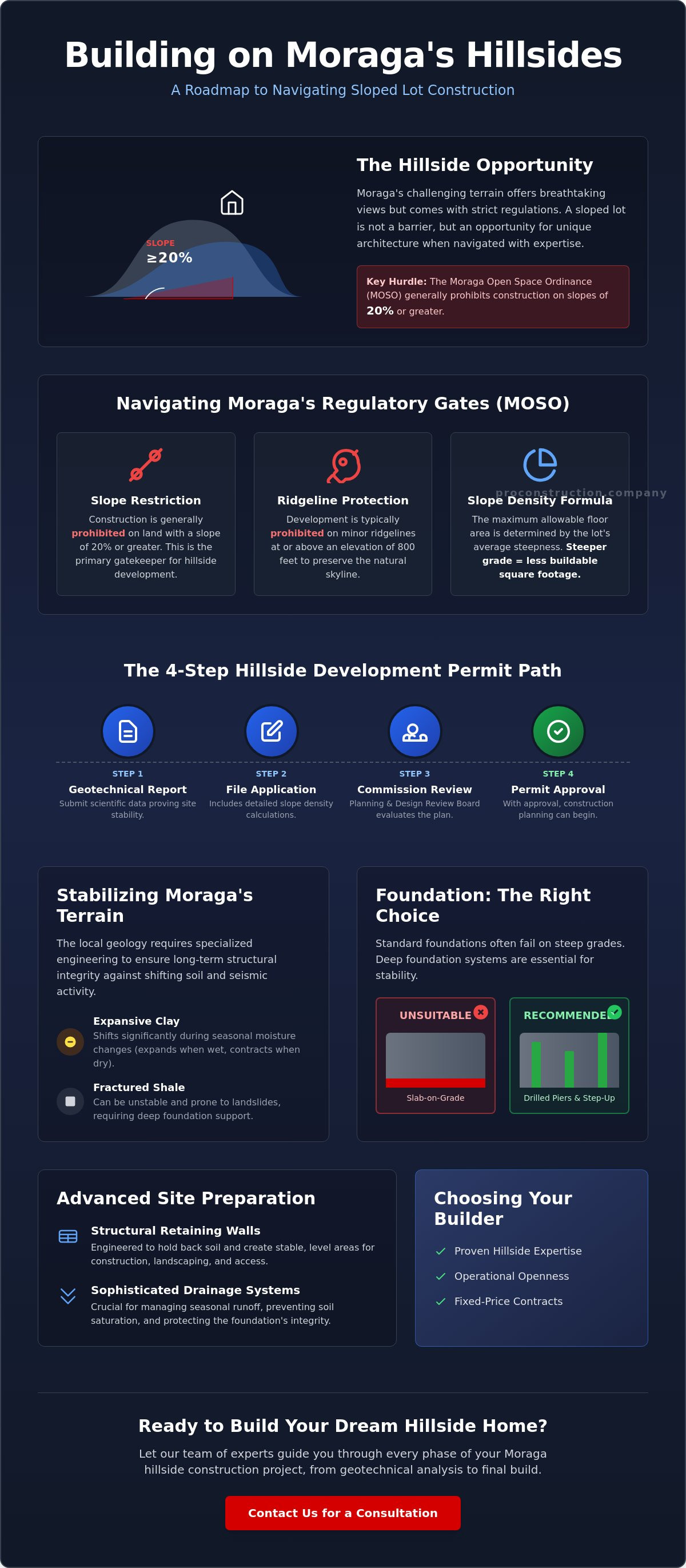
The Moraga Open Space Ordinance, commonly known as MOSO, serves as the primary gatekeeper for development on steep terrain. Established to protect the town’s semi-rural character, MOSO generally prohibits construction on slopes of 20% or greater. It also places strict protections on ridgelines. If your property includes a minor ridgeline, defined as a ridge at an elevation of 800 feet or higher, development is typically prohibited. These regulations influence more than just where you build; they impact lot coverage and building height to ensure the home does not dominate the landscape. We analyze these scenic corridor restrictions early in the planning phase to determine the viable building envelope for your custom home.
The Hillside Development Permit Process
If your project involves grading or construction on land with a slope of 20% or greater, you must obtain a Hillside Development Permit. This process is structured to mitigate the risks of soil instability and visual impact. The Town of Moraga Planning Department requires a comprehensive application that includes a detailed slope density formula. This formula is critical because it determines the maximum allowable floor area based on the average steepness of your lot. The steeper the grade, the less square footage you may be permitted to build.
A qualified geotechnical report is the first document you need before filing your application. This report provides the scientific data necessary to prove the site can safely support a structure. Once submitted, your project faces review by the Planning Commission, which also functions as the Design Review Board. They evaluate how the home integrates with the hillside and whether it minimizes grading. We manage this entire progression, from coordinating with engineers to representing your vision during public hearings. Our goal is to provide a predictable path through these administrative requirements, turning a complex permit process into a manageable phase of your project.
Geotechnical Engineering: Stabilizing the Moraga Terrain
The soil beneath Moraga is as complex as the regulations governing it. Building a home on a sloped lot in Moraga requires a deep understanding of the local geology, which primarily consists of expansive clay and fractured shale. These materials are notorious for shifting during seasonal moisture changes, expanding when wet and contracting when dry. We rely on geotechnical engineers to perform site-specific soil borings and seismic analysis before any heavy equipment arrives. Their findings dictate the structural requirements for your foundation, ensuring the home remains anchored despite the inherent landslide risks and seismic activity typical of Contra Costa County. This technical due diligence is a prerequisite for your hillside development permit and serves as the primary safeguard for your investment.
While slab-on-grade foundations work for flat parcels, they often fail to meet the demands of a steep grade without massive, costly excavations. We typically favor raised foundations for hillside projects. This approach allows for better drainage management and provides easier access to utilities. By elevating the structure, we minimize the disruption to the natural terrain and reduce the volume of soil that needs to be hauled away. We prioritize these methods to balance structural integrity with environmental stewardship.
Foundation Systems for Steep Grades
Deep foundation techniques provide the necessary stability when surface soils are unreliable. We frequently utilize drilled piers or friction piles that extend deep into the stable bedrock or denser soil layers. A step-up foundation design allows the structure to follow the natural contour of the hillside in a series of levels, which reduces the visual mass of the building. We use grade beams, which are reinforced concrete elements, to connect these piers and distribute the building's load evenly across the entire system. This meticulous engineering ensures the home remains rigid during seismic events and prevents differential settling over time.
Soil Stability and Erosion Control
Managing the angle of repose is a critical safety factor during the initial excavation. This term refers to the steepest angle at which soil remains stable without sliding. If the excavation exceeds this angle, we implement temporary shoring or permanent retaining structures immediately to prevent slope failure. Proper soil compaction is equally vital; we test every layer of fill to ensure it meets the structural specifications set by the engineer. Because Moraga experiences significant winter rainfall, we install temporary erosion control measures like silt fences and straw wattles to prevent sediment runoff. Our proactive approach to site management protects both your property and the surrounding watershed. If you are ready to discuss the technical requirements of your site, our team of custom home builders can provide a preliminary site assessment.
Designing for the Grade: Upslope vs. Downslope Layouts
The orientation of your land relative to the street is the most significant factor in your home’s final character. Building a home on a sloped lot in Moraga usually involves one of two primary strategies: the upslope or the downslope build. Each requires a distinct approach to site preparation and structural execution. We focus on how these layouts interact with the natural terrain to ensure the project remains compliant with the Moraga Open Space Ordinance (MOSO) Guidelines. While we don't provide architectural drawings, our role as your builder is to translate those designs into a stable, high-end reality that maximizes the unique potential of your specific grade.
The Upslope Design Strategy
Upslope lots position the home above the road, creating a commanding presence and an elevated "perch" for the residents. The primary technical hurdle here involves the driveway and garage placement. We often need to execute complex grading or build subterranean garages to keep driveway inclines within the town's safety limits. Privacy is another key consideration; because the home sits higher, we use strategic window placement and terraced landscaping to prevent the living areas from feeling exposed to the street below. One of the most effective ways to add value on an upslope lot is the daylight basement. This technique allows us to build a lower level that is partially underground on three sides but open to the front, providing additional square footage that feels light and airy without expanding the home's footprint.
The Downslope Design Strategy
Downslope lots are often favored for their dramatic, panoramic views. Since the house drops below the road level, the street-facing facade remains modest while the rear of the home opens up to the hills. We frequently build "inverted" floor plans on these sites. In this configuration, the main living areas and the primary suite sit on the top entry level to capture the best vistas, while guest rooms and secondary spaces occupy the levels below. Downslope builds offer a distinct advantage for infrastructure; they often allow for gravity-fed drainage and sewage systems, which reduces the need for mechanical pumps. However, they require significant structural support for cantilevered decks and overhanging rooms. We use heavy-duty steel or reinforced concrete to ensure these outdoor spaces are as stable as they are beautiful.
Regardless of the slope direction, accessibility is a priority for a modern custom home. We often install residential elevators to connect the multiple levels of a hillside build, ensuring the home remains functional for a lifetime. To bring natural light into the deeper parts of a hillside structure, we utilize light wells and clerestory windows. These features prevent the lower levels from feeling like a basement and instead create a bright, cohesive living environment. Our team ensures that every terraced entry and multi-level deck is built with precision, providing seamless transitions between the indoors and the stunning Moraga landscape.
Site Preparation: Retaining Walls and Advanced Drainage
Site preparation for building a home on a sloped lot in Moraga is the phase where theoretical engineering meets physical reality. We transform a raw, steep hillside into a stable and secure building platform through a series of disciplined, sequential steps. In established Moraga neighborhoods like Rheem or Campolindo, we often navigate narrow, winding roads that present significant logistical hurdles for heavy machinery. We coordinate the arrival of excavators and the staging of materials with surgical precision to maintain site safety and minimize disruption to the local community. Managing a constrained hillside site requires a builder who treats project management as a core competency rather than an afterthought.
Engineering Effective Retaining Walls
We distinguish between structural retaining walls and landscape walls based on their intended load and location. Structural walls are vital components that hold back the mass of the hillside to protect the home’s foundation or create the primary building pad. For any wall exceeding 4 feet in height in Moraga, we secure specific permits and follow engineered designs to ensure long-term stability. We typically choose between poured-in-place concrete for maximum strength, CMU blocks for versatility, or gravity walls that rely on sheer mass. Regardless of the material, we prioritize hydrostatic pressure management. Water trapped behind a wall is the primary cause of structural failure; therefore, we install a network of weep holes and high-drainage gravel backfill to allow moisture to escape safely.
Hydrology and Water Management
Moraga's winter rain cycles demand a sophisticated hydrology plan that goes beyond simple gutters. We integrate French drains and concrete V-ditches to capture and redirect water before it can saturate the soil near your foundation. A critical concept in our drainage strategy is managing sheet flow, which refers to the uniform movement of water across a sloped surface before it gathers into concentrated, erosive streams. We design these systems to protect your property while ensuring that runoff does not impact downhill neighbors. In cases where gravity alone is insufficient, we utilize catch basins and industrial-grade sump pumps to move water to the town's storm drain system.
Managing debris and staging materials on a constrained hillside is a logistical puzzle that we solve through operational discipline. We don't have the luxury of flat, sprawling space, so we schedule just-in-time deliveries to keep the site clear of unnecessary clutter. We utilize specialized, small-footprint equipment to navigate tight spaces without compromising on power or efficiency. This level of oversight ensures that the physical work remains organized from the first day of grading to the final inspection. If you're ready to break ground on a complex site, contact our team to discuss our advanced site preparation services.
Choosing a Moraga Custom Home Builder with Hillside Expertise
Selecting the right partner for your project is the final, and most critical, step in the process. Building a home on a sloped lot in Moraga involves variables that can quickly overwhelm an inexperienced team, from shifting soil conditions to the nuances of the Moraga Open Space Ordinance. We bring over 20 years of local Bay Area experience to every site, ensuring that the technical complexities of your foundation are handled with precision. Our team manages the synergy between geotechnical engineers and town officials to keep your project moving forward without unnecessary delays. We act as dedicated stewards of your investment, providing the professional oversight needed to turn a challenging grade into a structural masterpiece.
The Value of Local Experience
Local experience is not just a credential; it is a vital asset when dealing with Contra Costa County's specific geology. We have spent decades building relationships with the engineers and planners who oversee development in this region. This familiarity allows us to anticipate regulatory hurdles before they become bottlenecks, as detailed in our premier custom home builder in Contra Costa County 2026 guide. Understanding the unique logistics of hillside work, such as staging materials on narrow roads or managing heavy equipment on steep inclines, is what sets us apart. When you are evaluating general contractors in san francisco bay area, prioritize those who can demonstrate a proven track record of successful hillside completions within Moraga town limits.
Before you commit to a builder, we recommend asking several key questions to gauge their technical competence:
How many homes have you built in Moraga on slopes exceeding 20%?
What is your specific protocol for managing unforeseen soil instability once grading begins?
Do you provide a fixed-price contract that covers the complexities of hillside foundation work?
How do you coordinate with the Town of Moraga Planning Department during the Design Review phase?
Operational Openness in Hillside Construction
We believe that predictability is the foundation of a successful client relationship. Hillside projects are often prone to budget inflation due to the "hidden" nature of foundation work, but we combat this through operational openness and fiscal responsibility. We provide fixed-price contracts that offer a clear financial roadmap, ensuring that you aren't surprised by costs as we move through the excavation and pier-drilling phases. This transparency transforms the construction process from a stressful transaction into a collaborative effort. We maintain rigorous project supervision on every site, ensuring that every grade beam and retaining wall meets our high standards for quality and seamlessness. Ready to build your hillside masterpiece? Consult with our Moraga experts today to begin your shared journey toward a custom home that maximizes both your views and your peace of mind.
Transform Your Hillside Vision into a Moraga Reality
Securing a premier view requires more than just an ambitious design; it demands a fusion of regulatory precision and technical mastery. You now understand that successful construction on steep grades hinges on navigating the Moraga Open Space Ordinance and implementing advanced geotechnical solutions. From stabilizing expansive clay to managing complex drainage, every phase of building a home on a sloped lot in Moraga requires a builder who treats technical challenges as opportunities for excellence. We eliminate the typical anxieties of hillside work by providing the structural expertise and operational openness your project deserves.
With 23+ years of Bay Area expertise, we specialize in complex hillside engineering and provide the security of fixed-price residential construction contracts. Our team manages every variable of the grade to ensure your vision is realized with luxury and precision. We invite you to Start Your Moraga Hillside Project with a Professional Consultation. Let's work together to anchor your dream home into the stunning Moraga landscape with absolute confidence.
Frequently Asked Questions
Is it more expensive to build a home on a sloped lot in Moraga?
Yes, construction costs are higher on steep terrain due to the specialized engineering and site preparation required. Building a home on a sloped lot in Moraga involves deeper excavations, reinforced foundations, and complex grading that flat parcels don't require. We manage these variables through fiscal responsibility and fixed-price contracts to ensure your budget remains predictable. These additional requirements reflect the technical skill needed to anchor a luxury home into the hillside safely.
What is the maximum slope you can build on in Moraga?
The Moraga Open Space Ordinance (MOSO) generally prohibits development on slopes of 20% or greater. However, construction is possible if you obtain a Hillside Development Permit for land meeting specific town criteria. We work closely with the Planning Department to determine the exact slope density formula for your property. This ensures your project remains compliant with local regulations while maximizing the usable building envelope.
Do I need a special architect for a hillside home?
You should hire an architect who specializes in hillside terrain and possesses a deep understanding of Contra Costa County's building codes. While we don't provide architectural services, we collaborate with your design team to ensure the structural plans are feasible for physical execution. A specialist will understand how to integrate the home with the natural grade to minimize soil disturbance and meet the town's strict visual impact standards.
How long does the hillside permitting process take in Moraga?
The permitting timeline often takes several months because it requires reviews from the Planning Commission and the Design Review Board. Hillside projects face extra scrutiny regarding ridgeline protection and environmental impact. We recommend starting with a geotechnical report early to prevent delays during the application phase. Our established relationships with local officials help us navigate this bureaucratic progression with greater efficiency and predictability.
What are the biggest risks of building on a slope?
Soil instability and improper water management represent the most significant risks on a steep grade. Moraga’s expansive clay can shift during heavy winter rains, leading to differential settling or landslides if not properly engineered. We mitigate these risks by installing deep pier foundations and advanced drainage systems. Our focus on structural integrity ensures your home remains stable despite seismic activity or seasonal moisture changes.
Can I build an ADU on a sloped lot in Moraga?
Yes, you can build an Accessory Dwelling Unit (ADU) on a grade, provided the project meets state mandates and local hillside ordinances. Building a home on a sloped lot in Moraga often makes ADUs more complex, as they may require their own retaining walls or specialized foundation work. We evaluate your site’s topography to find the most cost-effective and structurally sound location for a secondary unit without compromising the main home’s views.
How do you handle sewage and plumbing on a downslope lot?
Downslope lots typically require a sewage ejector pump if the home sits below the level of the municipal sewer main. While upslope lots often benefit from gravity-fed systems, a downslope configuration uses mechanical pumps to move waste upward to the street. We install industrial-grade plumbing components and backup power systems to ensure these utilities remain reliable. Proper engineering of these systems prevents the common maintenance issues associated with hillside utility management.
What kind of retaining walls are best for Moraga soil?
Poured-in-place concrete and reinforced CMU (concrete masonry unit) walls are the most effective for Moraga’s challenging soil. These walls must be designed with deep footings that reach stable ground to resist the lateral pressure of shifting clay. We prioritize the installation of high-capacity drainage layers and weep holes to prevent hydrostatic pressure buildup. This meticulous approach to masonry ensures your retaining structures remain functional and aesthetically pleasing for decades.


Comments