


Converting a Room into a Garage: The Contra Costa County Homeowner’s Guide (2026)
- Santiago Martinez

- Apr 15
- 12 min read
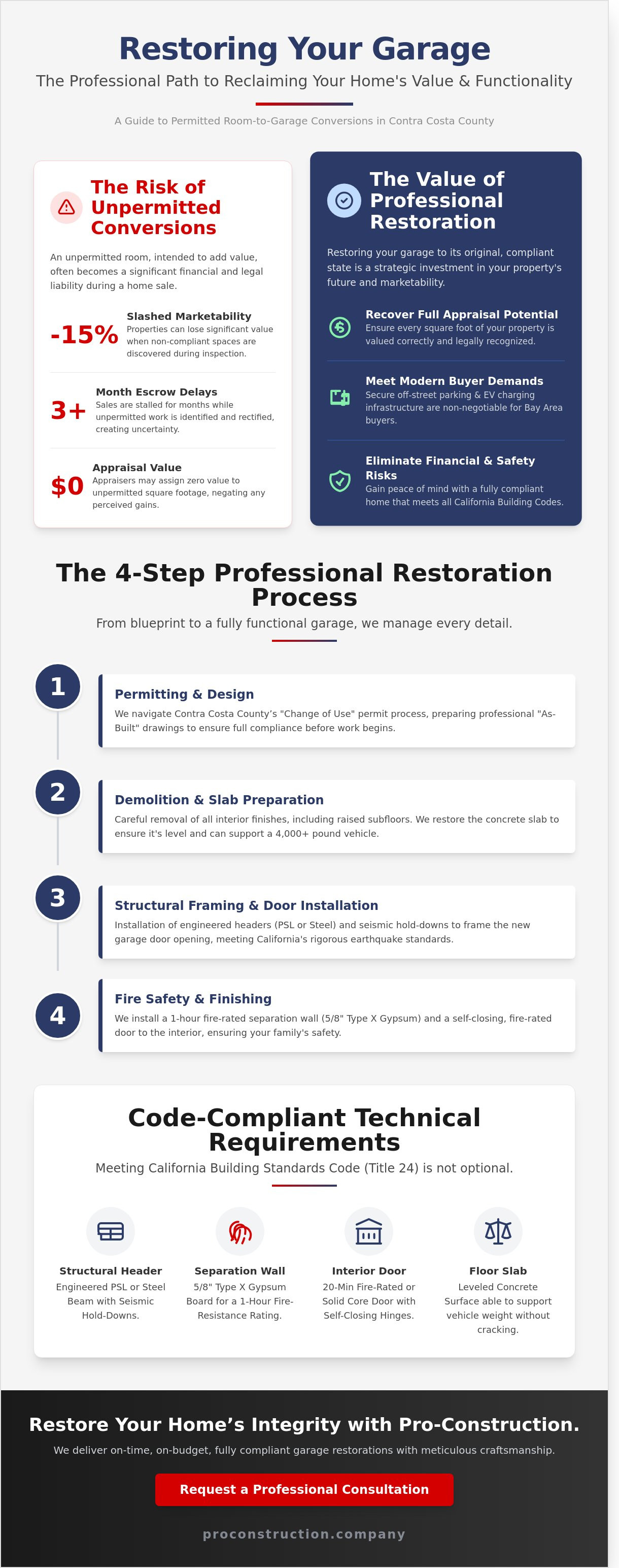
In 2025, a Walnut Creek homeowner discovered that an unpermitted living room conversion slashed their property's marketability by 15% during a routine home inspection. The very space intended to add value became a liability that stalled their escrow for three months. You likely recognize that while an extra bedroom seemed practical years ago, the loss of vehicle protection and secure storage creates daily friction. You want the peace of mind that comes with a home that meets every California building code requirement without compromise. This guide details the professional process of converting a room into a garage, ensuring your renovation meets the rigorous standards of Contra Costa County.
We believe in transparency and craftsmanship, providing you with a roadmap to restore your home's integrity and recover its full appraisal potential. Our partnership ensures a seamless transition from a living space back to a high-end utility area. We will break down the essential permitting phases, structural requirements, and the long-term ROI of returning your property to its original, intended excellence. We focus on on-time and on-budget delivery so you can reclaim your home’s functionality with absolute confidence.
Key Takeaways
Understand why restoring your garage increases property value in the Bay Area by meeting the high demand for off-street parking and modern EV charging infrastructure.
Learn the technical requirements for a seamless restoration, from evaluating slab level transitions to verifying structural headers for your new garage door.
Master the complexities of converting a room into a garage by navigating Contra Costa County’s "Change of Use" permit process and professional "As-Built" drawing requirements.
Identify the primary cost drivers and specialized trades involved to ensure your project remains on-budget and transparent throughout the demolition and framing phases.
Discover how a disciplined, end-to-end management approach ensures your home’s original integrity is restored with meticulous craftsmanship and professional oversight.
Table of Contents Understanding the "Reverse Conversion": Why Restore Your Garage in 2026? Structural and Technical Requirements for Professional Restoration Navigating Permitting and Compliance in Contra Costa County Budgeting for Your Garage Restoration: Cost Drivers in the Bay Area The Pro-Construction Approach: Seamless Garage Restorations
Understanding the "Reverse Conversion": Why Restore Your Garage in 2026?
We view the process of converting a room into a garage as a strategic restoration of a home’s original utility. In the current Bay Area real estate market, homeowners are moving away from the "more is better" approach to square footage. They now prioritize the high-value infrastructure that only a functional garage provides. A reverse garage conversion is a structural restoration to original building specs.
In 2026, Bay Area buyers treat off-street parking and dedicated EV charging infrastructure as non-negotiable requirements. As California continues its transition toward zero-emission vehicles, the garage has evolved from a simple storage area into a critical energy hub for the modern household. We help clients reclaim this space to ensure their property remains competitive and functional in a changing landscape.
The Shift in Contra Costa Real Estate Trends
Homeowners in cities like Walnut Creek and Concord are increasingly moving away from makeshift living spaces in favor of utility. This shift is largely driven by local street parking regulations that have become significantly more restrictive over the last 24 months. Private, secure parking offers a level of convenience and security that street spots cannot match. Additionally, a functional garage supports modern lifestyle needs that a bedroom cannot; it provides the necessary foundation for high-end home workshops, precision hobby spaces, and organized storage systems that maintain the home's interior clarity.
Legal and Financial Risks of Non-Compliant Conversions
The "unpermitted room" dilemma is a major hurdle for sellers in Contra Costa County. When a garage is converted without proper oversight, it often creates a liability that surfaces during the appraisal process. Appraisers may assign zero value to unpermitted square footage or, worse, require a full restoration to original specs before a sale can close.
Safety and compliance are our primary concerns. Insurance companies frequently scrutinize unpermitted spaces during claims; they may deny coverage if a structural or electrical issue originates in a room that fails to meet the California Building Standards Code (Title 24). The Contra Costa County Building Inspection Division maintains strict code enforcement to ensure residential safety. By converting a room into a garage through a professional, permitted process, we eliminate these financial risks and restore the home's legal integrity. We provide end-to-end solutions that handle the complexities of local building departments, ensuring your project is delivered on-time and fully compliant.
Structural and Technical Requirements for Professional Restoration
Converting a room into a garage involves a complex reversal of previous modifications. We begin by evaluating the existing slab. Most interior conversions involve adding floor finishes like laminate, tile, or thick carpets. We remove these materials to reveal the underlying concrete. If a previous contractor installed a raised subfloor to match the home's interior height, we dismantle it entirely. This restoration ensures the floor can support the weight of a 4,000-pound vehicle without cracking. We also check for level transitions to prevent water from pooling near the entry points.
The 2026 California Residential Code sets high standards for fire safety during these projects. We ensure the wall separating the garage from the living space features 5/8-inch Type X gypsum board. This material provides a 1-hour fire-resistance rating. We also inspect the door connecting the garage to the house. It must be a 1-3/8 inch solid wood door, a honeycomb-core steel door, or a 20-minute fire-rated door. We install self-closing hinges on these doors to meet strict safety protocols and maintain the integrity of the fire barrier.
Reinstalling the Garage Door Opening
Restoring the garage door opening requires significant structural work. We install engineered headers, such as Parallel Strand Lumber (PSL) or steel beams, to support the roof load. In seismic-prone areas like Walnut Creek, we secure these headers with heavy-duty hold-downs and straps. These components provide the lateral strength necessary for earthquake resilience. When choosing a door, we prioritize high-density insulation. This keeps the garage temperate and improves the home's overall curb appeal. We also integrate smart opener systems that feature rolling code technology and smartphone alerts for enhanced security.
Mechanical and Utility Decommissioning
We manage the removal of all systems that are no longer code-compliant for a garage environment. This includes pulling back HVAC ducting and sealing the supply lines to prevent exhaust fumes from entering the home. We cap plumbing lines behind the finished walls to eliminate the risk of leaks. Converting a room into a garage also requires a full audit of the electrical system. We often upgrade panels to support a 3-phase electric car charger or similar high-capacity EV charging needs. This addition ensures your home is ready for the next generation of transportation. Our experts offer a detailed consultation to help you plan these technical upgrades efficiently.
Navigating Permitting and Compliance in Contra Costa County
Navigating the legalities of converting a room into a garage requires a disciplined approach to local codes. In Contra Costa County, this transition is officially classified as a "Change of Use." It isn't a simple cosmetic swap; it's a legal reclassification of your property's footprint from habitable living space back to unconditioned utility space. We manage the submission of "As-Built" drawings to the Building Inspection Division. These documents prove the structural integrity and safety of the restoration. Professional oversight is mandatory here because hand-drawn sketches don't meet the rigorous standards of Bay Area inspectors.
Reverting a conditioned room to an unconditioned garage also triggers Title 24 energy reviews. You must prove the home's remaining living area stays energy efficient once the interior wall becomes an exterior-facing thermal barrier. We provide the technical data to satisfy these requirements, ensuring your home stays comfortable and compliant. Our goal is to provide a seamless transition that protects your property value and your peace of mind.
The Application Process for Restoration Permits
Our team starts by gathering comprehensive site plans and interior floor plans. For residents in cities like Concord or Danville, the timeline for permit approval usually spans 30 to 60 days. We manage the entire lifecycle of the permit to provide a "no-surprises" experience. By handling the paperwork and municipal communications, we eliminate the friction often found in local bureaucracies. This partnership ensures the project stays on track and meets every legal milestone without delay.
Meeting 2026 California Building Standards
Compliance with the 2026 California Building Standards is non-negotiable for safety and insurance purposes. When converting a room into a garage, specific physical modifications are required to protect the main residence. We focus on these critical safety elements:
Fire-Rated Barriers: We install 5/8-inch Type X drywall on all walls and ceilings shared with the living space to meet fire code.
Gas-Tight Sealing: Every penetration in the shared wall is sealed to prevent vehicle exhaust fumes from entering the home.
Floor Grading: We verify or adjust the concrete floor so it slopes toward the garage door for proper drainage of automotive fluids.
Seismic Safety: If your water heater is located within the garage space, we install double seismic strapping to meet current earthquake safety mandates.
Once the construction phase concludes, we schedule and attend the final inspection with the county. Successfully passing this inspection is the only way to clear the permit and ensure no code violations appear on your property title. This meticulous attention to detail ensures your investment is protected and your home remains fully compliant with California law.
Budgeting for Your Garage Restoration: Cost Drivers in the Bay Area
Restoring a functional garage requires a strategic financial plan that accounts for the unique economic pressures of Northern California. The primary cost factors include the demolition of non-load-bearing walls, structural framing adjustments, and the reintegration of specialized trades. When you are converting a room into a garage, the structural integrity of the slab and the overhead header must be the top priority. Localized labor rates in the Bay Area significantly influence the total investment; skilled trade costs in cities like Walnut Creek or San Ramon often exceed national averages by 35% due to high demand and living costs.
The complexity of the previous conversion dictates the restoration price. If the original project involved removing extensive insulation, adding subflooring, or rerouting HVAC ducting, the labor hours required to strip the space back to its original purpose will increase. We focus on a "no-surprises" philosophy by auditing the existing structure before work begins. This transparency ensures you understand exactly how your budget is allocated to restore the building's utility. Professional restoration is almost always a more sound financial choice than the potential loss in home sale value that occurs when a property lacks a functional garage.
Material and Labor Considerations
High-quality garage doors and automated systems represent a substantial portion of the material budget. Selecting a bespoke, insulated door improves both curb appeal and energy efficiency. We find that electrical and plumbing rerouting often requires specialized "Time and Materials" fees because utility lines hidden behind drywall during the initial conversion can be unpredictable. Leveraging professional project management is the most effective way to avoid the hidden costs of DIY mistakes. Errors in framing or track alignment can inflate a budget by 25% due to the need for corrective rework.
ROI: How a Garage Restoration Pays Off
A garage restoration is a calculated investment in your property's equity. In Contra Costa County, homes with a functional 2-car garage typically see a value increase ranging from $30,000 to $55,000 compared to those with converted living spaces. Beyond the immediate financial gain, a "clean" title with all permits finalized provides a massive marketability advantage. Buyers in the 2024 market prioritize move-in-ready homes with legal, permitted configurations.
For many homeowners, restoring this space is a necessary prerequisite for starting a custom home builder project. It establishes a baseline of structural integrity and legal compliance for future expansions or ADU developments. We view every restoration as a partnership aimed at maximizing your property's potential through disciplined execution and craftsmanship. If you want to ensure your property reaches its full market potential, contact ProConstruction to discuss an end-to-end restoration solution.
The Pro-Construction Approach: Seamless Garage Restorations
Restoring a home to its original layout requires more than just removing interior walls. We bring 23 years of experience in the San Francisco Bay Area to every project, ensuring your home regains its functional value and structural integrity. Our team treats converting a room into a garage as a precision engineering task rather than a simple demolition job. We apply meticulous craftsmanship to every structural detail, from reinforcing load-bearing headers to matching your home's exterior siding and trim. Our goal is to make the restoration look as if the garage was never modified.
We operate on a partnership model that prioritizes your peace of mind. You'll stay informed from the moment we file the first permit through the final inspection. This transparent approach eliminates the typical anxieties associated with high-end renovation. We take pride in our "no-surprises" philosophy, which has made us a trusted name for complex Bay Area restorations since 2001. We act as dedicated stewards of your investment, delivering results that are both on-time and on-budget.
Why Expertise Matters for Structural Reversals
Many homeowners face significant challenges when reversing a previous conversion. You must avoid the common pitfalls associated with converting garage into living space by ensuring the reverse process meets current California building codes. Our extensive history building Accessory Dwelling Units (ADUs) gives us a unique advantage. We understand the plumbing, electrical, and structural nuances of these spaces. We ensure your new garage door, concrete slab height, and ventilation systems integrate perfectly with your home's existing aesthetic.
Your Path to a Legal, Functional Garage
The journey begins with a comprehensive feasibility study for your Contra Costa property. We analyze local zoning requirements and structural needs to provide a clear roadmap for your restoration. Pro-Construction utilizes transparent, fixed-price contracts for every project. This ensures you know the exact scope and cost before we break ground. Our structured process includes:
Detailed site evaluation and structural assessment.
Permit procurement and coordination with local building departments.
Professional demolition and high-end material matching.
Final inspections to verify total code compliance and safety.
Reclaiming your vehicle storage and workshop space shouldn't be a stressful ordeal. When converting a room into a garage, you need a partner who values discipline and detail. Contact Pro-Construction today to schedule your professional site evaluation. Let's start the process of restoring your home's original excellence together.
Reclaiming Your Home’s Structural Value and Function
Restoring your property’s original footprint is a strategic investment in both marketability and long-term structural health. By 2026, Contra Costa County building codes have become increasingly specific regarding fire separation and technical ventilation. Successfully converting a room into a garage demands a meticulous approach to permit resolution and technical execution. We focus on transparency throughout the entire process to ensure your project remains on-schedule and meets every local compliance standard. Our team brings 23 years of Bay Area expertise to every site; we're fully licensed, bonded, and insured to handle complex structural restorations. We prioritize integrity in our craftsmanship to provide you with a seamless transition from living space back to a functional, high-end garage. We operate with a no-surprises philosophy that protects your investment from the first consultation to the final inspection. Your vision deserves a partner who values precision and disciplined project management. Partner with Pro-Construction for your professional garage restoration and secure your home’s value with confidence.
Frequently Asked Questions
Do I need a permit to convert a room back into a garage in Contra Costa County?
Yes, you must obtain a building permit from the Contra Costa County Building Inspection Division. This ensures the space meets current California Building Code standards for fire separation and structural integrity. We manage this entire process to ensure full compliance with local ordinances. Our team handles the documentation and inspections so your home remains legally compliant and safe.
How much does it cost to reverse a garage conversion in the Bay Area?
Costs depend on the complexity of removing drywall, flooring, and HVAC extensions. According to 2023 industry benchmarks for the San Francisco-Oakland-Hayward area, labor rates for licensed contractors reflect the region's high cost of living. We provide a detailed line-item estimate during our consultation to ensure transparency. This includes the removal of non-structural walls and the installation of a code-compliant garage door.
Will converting my room back into a garage increase my home value?
Restoring a garage often increases marketability in the Bay Area. Data from the National Association of Realtors indicates that homes with functional garages sell faster than those without. In high-density neighborhoods like Berkeley or San Francisco, off-street parking is a primary requirement for 85% of prospective buyers. Converting a room into a garage restores the original utility and appeals to a wider pool of investors.
Can I keep some of the living space features, like insulation, in my new garage?
You can certainly retain features like wall insulation and finished ceilings. Keeping high-grade insulation helps regulate the temperature of the adjacent living areas and reduces energy consumption. We ensure these elements meet the specific fire-rated requirements for garages, such as 5/8-inch Type X gypsum board on the shared walls. This approach maintains a level of comfort while adhering to strict safety protocols.
How long does the restoration process typically take?
A standard restoration typically takes between 3 and 6 weeks from the start of demolition to the final inspection. When converting a room into a garage, this timeline accounts for structural adjustments, electrical rerouting, and the lead time for custom garage door orders. We provide a firm project schedule before we break ground. Our disciplined project management ensures we meet every milestone on time and within the agreed scope.
What happens if the original conversion was done without permits?
If the previous conversion didn't have permits, you must bring the space into compliance during the restoration. The Contra Costa County Building Department requires an as-built inspection to identify safety violations. We specialize in resolving these issues by correcting unpermitted electrical or plumbing work. Our partnership ensures the restoration clears all municipal records, protecting your investment during future property appraisals or sales.
Is a new garage door installation included in a standard restoration?
Yes, we include the installation of a new, insulated garage door as a core component of the restoration. We offer bespoke options that match your home's architectural style and meet California's Title 24 energy standards. This includes the heavy-duty tracks, high-cycle springs, and a smart opener system. Our team ensures the opening is structurally reinforced to support the weight and movement of the new door.
Do I need to upgrade my electrical panel when converting back to a garage?
You don't always need a full panel upgrade, but we evaluate your system's capacity during the design phase. If you plan to install a Level 2 Electric Vehicle charger, a 200-amp panel is typically the standard requirement. We inspect your existing breakers to ensure they can handle the new load safely. Our electricians provide a seamless integration that supports both modern technology and traditional utility needs.


Comments