


ADU Financing Options in Contra Costa County: The 2026 Homeowner’s Guide

What if your backyard could generate a 35% return on investment, but the complexity of funding stopped you before the first shovel hit the dirt? Most homeowners in cities like Walnut Creek and San Ramon understand the long-term value of an Accessory Dwelling Unit, but the initial capital remains a significant hurdle. We recognize that high construction costs in the Bay Area create real anxiety, especially when you're trying to distinguish between a HELOC and a specialized construction loan. Identifying the right adu financing options contra costa county offers is the first step toward a seamless project that respects your financial boundaries.
We believe in absolute transparency and a no-surprises approach to your investment. You deserve a clear path to funding that prioritizes your peace of mind and the integrity of your property. This guide provides a detailed comparison of four primary funding routes, including the latest 2026 local grant updates and bespoke loan products designed for Bay Area residents. We'll outline how to leverage state programs like CalHFA alongside private lending to ensure your project stays on-time and on-budget from start to finish.
Key Takeaways
Identify the most advantageous adu financing options contra costa county provides to capitalize on rising East Bay property values and rental demand.
Unlock local incentives and 2026 grant updates that can significantly offset your initial construction and permitting expenses in cities like Walnut Creek and Richmond.
Evaluate the strategic benefits of specialized ADU construction loans versus traditional equity lines to maintain optimal cash flow during your project.
Guard against budget overruns by mastering the specific utility hookup and impact fees required across various Contra Costa jurisdictions.
Discover how a dedicated end-to-end partnership streamlines complex lender requirements for a transparent, on-time, and on-budget project delivery.
Table of Contents Why Contra Costa Homeowners are Prioritizing ADUs in 2026 Comparing ADU Financing Options: Which is Right for You? Local Grants and State Incentives for Contra Costa ADUs Budgeting for Success: Avoiding Construction Cost Overruns The Pro-Construction Roadmap: From Funding to Finished ADU
Why Contra Costa Homeowners are Prioritizing ADUs in 2026
Contra Costa County homeowners face a distinct housing landscape in 2026. High demand for flexible living spaces has transformed the Accessory Dwelling Unit (ADU) from a luxury addition into a strategic financial asset. We see a growing trend where residents prioritize these structures to combat rising living costs and maximize their property's footprint. In Walnut Creek, the demand for premium one-bedroom rentals has increased by 14% since 2024, while Concord residents seek affordable workforce housing at record rates. This surge makes understanding adu financing options contra costa county essential for anyone looking to build equity through disciplined construction.
Property values in the East Bay continue to show resilience. Adding a bespoke cottage typically boosts total property equity by 25% to 30%, providing a powerful hedge against market volatility. Beyond the financial gains, the "Silver Tsunami" remains a local reality. With 21% of our county population now over the age of 65, multi-generational housing solutions are no longer optional. These units allow families to stay together while maintaining privacy and independence. New 2026 legislative updates have further streamlined the process, removing previous setbacks and parking requirements that once stalled development. We manage these projects with a focus on transparency, ensuring your vision meets both local code and high craftsmanship standards.
Rental Income Potential in the East Bay
The rental market in San Ramon and Danville offers lucrative opportunities for homeowners. As of early 2026, a high-end 1-bedroom ADU in San Ramon commands an average monthly rent of $2,950, while similar units in Danville often reach $3,200. We analyze the "Cap Rate" for these backyard cottages to ensure they function as high-performing investments. Most suburban Contra Costa projects currently yield a 7.5% to 9% return on investment. The current local rental yield for a standard 600-square-foot ADU in the county is approximately 8.2% annually.
Property Tax Implications for Contra Costa Residents
We prioritize clarity when discussing the financial impact of new construction on your tax bill. The Contra Costa County Assessor applies a "blended" assessment approach. This means your primary residence retains its original Proposition 13 base value, and only the new ADU is assessed at current market rates. This method prevents a full property tax reset, protecting your long-term investment. Additionally, homeowners who commit to building affordable housing units may qualify for specific local tax incentives or fee waivers under state-wide equity programs. Our partnership ensures you understand these fiscal details before the first shovel hits the ground.
Comparing ADU Financing Options: Which is Right for You?
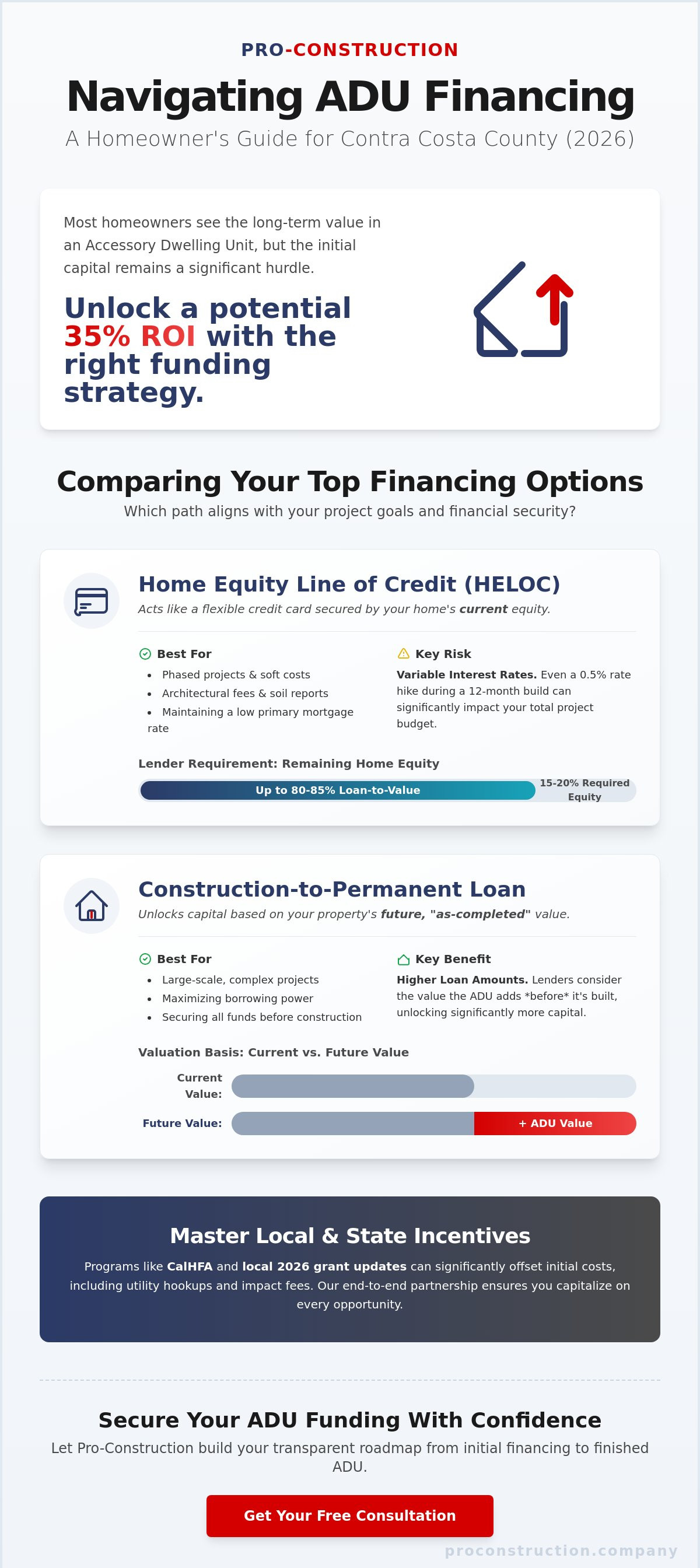
Selecting the right capital source is as critical as the architectural design. In 2026, homeowners looking for adu financing options contra costa county must weigh immediate liquidity against long-term interest costs. While cash-out refinancing was a dominant strategy in 2021; the current rate environment often favors keeping your primary mortgage intact while layering specialized financing on top. We focus on helping you identify a path that protects your home's equity while maximizing its potential.
HELOCs: Flexibility for the Phased Project
A Home Equity Line of Credit (HELOC) acts like a credit card secured by your home. We often see clients utilize this for soft costs, such as architectural fees and soil reports, before the main construction begins. Most Contra Costa lenders require at least 15% to 20% equity remaining in the primary residence after the line is drawn. While flexible, you must account for the risk of variable rates. During a 12-month build cycle, even a 0.5% rate hike can impact your total project budget. It's essential to align your funding with Contra Costa County ADU requirements to ensure your project remains compliant and eligible for continued funding.
Construction-to-Permanent Loans
These specialized loans are becoming the standard in the Bay Area. Unlike traditional equity products, lenders evaluate the "as-completed" value of your property. This means they consider what the home will be worth once the ADU is finished, which often unlocks significantly more capital for the build. We find this approach provides the most security for complex projects.
One-Time Close: This benefit saves you on closing costs, often reducing fees by up to 30% compared to traditional two-step financing.
Interest-Only Periods: You typically only pay interest on the funds as they're drawn during the construction phase.
Structured Draw Schedules: The lender releases funds as we reach specific milestones, ensuring the project stays on track and on budget.
Fannie Mae HomeStyle and Freddie Mac ChoiceRenovation offer alternative paths for those with less than 20% equity. These programs allow you to bundle the ADU costs into a single mortgage. As of early 2026, these options are increasingly popular for homeowners who purchased their properties within the last 36 months. We recommend a thorough audit of your current mortgage terms before committing to a full refinance. If you're ready to see how these numbers apply to your specific lot, our team can help you develop an end-to-end project plan that aligns with your financial goals.
Local Grants and State Incentives for Contra Costa ADUs
Securing non-repayable capital is the most effective way to reduce your total project cost and improve your return on investment. While many homeowners focus solely on traditional loans, the landscape of adu financing options contra costa county includes several grant programs designed to offset the high costs of pre-development and construction. We prioritize transparency in our partnership with you, ensuring you understand exactly which state and local funds are available to bolster your budget before we break ground.
Maximizing the CalHFA $40,000 Grant
The CalHFA ADU Grant Program remains a vital resource in 2026 for homeowners meeting specific income requirements. This program provides up to $40,000 to cover soft costs that often catch owners by surprise. To qualify, you'll need to follow a disciplined sequence of actions:
Secure a construction loan: You must have a primary financing source in place through a CalHFA-approved lender.
Submit pre-development receipts: The grant specifically covers architectural drawings, soil reports, environmental studies, and permit fees.
Verify income eligibility: Your household income must fall below the established limits for Contra Costa County, which are updated annually based on regional median data.
Homeowners often lose their eligibility by paying for these services out of pocket before their grant application is officially registered. We've seen projects stall because owners didn't realize that work completed prior to the application date is generally ineligible for reimbursement. You should pair this state grant with a private construction loan or a HELOC to create a seamless funding structure that covers both the initial design phase and the physical build.
Utility Rebates and Green Financing
Building an energy-efficient unit doesn't just lower future utility bills; it unlocks immediate cash incentives. BayREN (Bay Area Regional Energy Network) offers direct rebates for homeowners in the East Bay who implement high-performance upgrades. You can receive up to $1,000 for installing heat pump water heaters and additional rebates for high-efficiency attic insulation or duct sealing. These funds act as a direct reduction of your capital expenditure.
Integrating solar panels into your project is another smart way to optimize your adu financing options contra costa county. Since California’s Title 24 standards require solar for new detached ADUs, you can include the installation costs in your primary construction loan. This strategy allows you to claim the 30% Federal Investment Tax Credit on the solar portion of the build, which provides a significant dollar-for-dollar reduction in your federal tax liability. All-electric ADUs qualify for the highest tier of green incentives while eliminating the expensive requirement for new gas line extensions.
For those looking to support the community, Richmond and Walnut Creek offer specific local advantages. Richmond provides impact fee waivers for units under 750 square feet, which can save you between $5,000 and $12,000 in municipal costs. Walnut Creek has streamlined its review process for "bespoke" ADU designs, reducing the carrying costs associated with long permit wait times. If you're willing to commit to a 10-year low-income housing agreement, you may also qualify for forgivable loans through the California Accelerator program, essentially turning a portion of your debt into equity over time.
Budgeting for Success: Avoiding Construction Cost Overruns
Securing your capital is only the first step in the journey; protecting that investment during the build phase requires disciplined financial oversight. When exploring adu financing options contra costa county, homeowners must account for "soft costs" that frequently remain hidden until the permitting phase begins. These include utility hookups, environmental impact fees, and specialized engineering reports required for the varied terrain of the East Bay. We prioritize transparency to ensure these figures are integrated into your initial loan application, preventing mid-project funding gaps.
Lenders view variable-price or "cost-plus" contracts as a significant red flag. These agreements make it impossible to establish a firm loan-to-value ratio, which can lead to complications during the appraisal process or even loan denial. We mitigate this risk by utilizing fixed-price residential contracts. This approach provides the structural clarity banks require and the peace of mind you deserve. A professional financing plan should also include a dedicated contingency fund, typically 10% to 15% of the total project cost. This buffer manages unforeseen site conditions, such as outdated sewer lines or soil stability issues, without compromising your primary budget.
Navigating Contra Costa Permitting Fees
Permitting costs in the East Bay are not uniform. Under California state law SB 13, ADUs smaller than 750 square feet are exempt from impact fees, but units exceeding this size face varying charges based on the local district. For instance, school impact fees in the Lafayette School District or Orinda Union School District differ significantly from those in unincorporated areas governed directly by the county. Additionally, sewer connection charges from the Central Contra Costa Sanitary District can add several thousand dollars to your budget. Working with the Top ADU Contractors in Contra Costa County ensures these local variables are identified early in the design phase.
The Value of Fixed-Price Residential Contracts
We believe in end-to-end solutions that eliminate the anxiety of "change orders." A fixed-price agreement acts as a financial anchor, protecting your equity from market volatility and material price spikes. Our pre-construction planning is meticulous; we identify structural requirements and utility alignments before a single contract is signed. This commitment to excellence ensures that your project remains on-time and on-budget. By providing a clear, all-in cost structure, we foster a partnership built on integrity. This disciplined project management reduces financial risk and ensures your bespoke ADU is a seamless addition to your property.
Ready to build with certainty?
to discuss your fixed-price ADU project.
The Pro-Construction Roadmap: From Funding to Finished ADU
Securing capital is only the first step in your journey. We bridge the gap between your financial approval and a completed structure through a disciplined, end-to-end management approach. Since 2001, we've established a 23-year track record of excellence in the San Francisco Bay Area. We understand that lenders require specific documentation, including architectural drawings and detailed cost breakdowns, before releasing funds. We provide these feasibility studies and technical packets to ensure your adu financing options contra costa county are fully supported by professional data.
We treat every project as a partnership. This means we take responsibility for the complex coordination between engineers, city planners, and tradespeople. Our team handles the following critical tasks:
Detailed site feasibility assessments to identify utility and zoning constraints.
Preparation of comprehensive project timelines for lender milestones.
Management of the Contra Costa County permitting process to avoid costly delays.
Regular budget audits to maintain fiscal transparency.
Our experience allows us to anticipate challenges before they become expenses. We act as your dedicated steward, ensuring that the vision you've financed is the one we deliver. By integrating our construction expertise with your financial planning, we create a streamlined path to project completion.
Seamless Execution and Professional Craftsmanship
Our commitment to on-time and on-budget delivery is the cornerstone of our reputation. We utilize a "No Surprises" philosophy that protects East Bay homeowners from the common pitfalls of construction. This proactive stance involves thorough pre-construction planning that accounts for the specific soil and topographic conditions of the region. If you're exploring How to Change Your Garage to Living Space, our expertise ensures the conversion meets all 2026 California building codes while maximizing your property's value. We prioritize integrity in every joint and finish, delivering bespoke ADUs that stand the test of time.
Your Next Steps in Contra Costa
The path to a successful ADU begins with a professional site evaluation. We'll meet at your property to determine the physical and financial feasibility of your vision. During this consultation, we can review our portfolio of completed projects in cities like Walnut Creek, Lafayette, and San Ramon. This allows you to see the level of craftsmanship we bring to every build. We'll help you align your project goals with the most effective adu financing options contra costa county available today. Our goal is to transform your property into a source of long-term value and utility. Partner with Pro-Construction for your ADU project to ensure your investment is managed with the highest level of professional oversight.
Secure Your Investment with a Strategic Contra Costa ADU
Navigating the diverse adu financing options contra costa county residents can access in 2026 requires a disciplined approach to both state incentives and private lending. Successful projects often hinge on leveraging programs like the CalHFA ADU Grant or specific municipal incentives to offset initial soft costs. We've seen that meticulous planning prevents the 20 percent budget overruns frequently reported in industry studies. By choosing a fixed-price residential contract, you shield your equity from the market volatility that often disrupts unmanaged builds. It's about turning a complex financial puzzle into a seamless addition to your property.
Pro-Construction brings 23 years of Bay Area expertise to your backyard, ensuring every phase of development aligns with your long-term goals. Our A+ rating for transparency is built on a foundation of integrity and end-to-end management. We act as a dedicated steward of your investment, providing the professional oversight needed to deliver excellence on time. You're not just building a structure; you're creating a bespoke living space through a reliable partnership. Start your Contra Costa ADU journey with a professional estimate from Pro-Construction and watch your vision take shape with total peace of mind.
Frequently Asked Questions
What is the average cost of an ADU in Contra Costa County in 2026?
The average cost to build a detached ADU in Contra Costa County ranges from $250,000 to $400,000 as of early 2026. These figures include design, permitting, and construction costs based on recent regional development data. Junior ADUs typically cost less, often falling between $80,000 and $150,000 because they utilize existing square footage. We ensure every project follows a transparent budget to eliminate financial surprises.
Can I finance an ADU if I don’t have much equity in my primary home?
You can finance an ADU with limited equity by using renovation-based loans like the Fannie Mae HomeStyle or FHA 203k programs. These products base the loan amount on the "as-completed" value of your property rather than its current appraisal. This approach allows you to borrow up to 95% of the projected future value. It's a strategic way to explore adu financing options contra costa county without a large upfront cash reserve.
Do ADUs qualify for traditional 30-year fixed mortgages?
Traditional 30-year fixed mortgages are available for ADU construction through specific construction-to-permanent loan products. In 2024, Fannie Mae updated its guidelines to allow lenders to consider 75% of the projected rental income from the ADU to help you qualify. This change makes it easier for homeowners to secure long-term, stable interest rates for their secondary units. We help you navigate these requirements through our end-to-end solutions.
How long does it take to get an ADU loan approved in the Bay Area?
ADU loan approval typically takes between 30 and 45 days for standard products like HELOCs or cash-out refinances. Renovation loans often require 60 days due to the additional appraisal and contractor vetting steps. We maintain a meticulous schedule to ensure your financial documentation aligns with the 60-day permit window mandated by California Senate Bill 13. Our partnership ensures your project stays on track.
Are there specific grants for building ADUs for elderly family members?
Specific grants for elderly family housing exist through the Contra Costa County Department of Conservation and Development. Programs like the Neighborhood Preservation Program provide low-interest, deferred-payment loans up to $60,000 for qualifying senior-related improvements. These funds target homeowners who meet specific low-to-moderate income thresholds defined by HUD's 2025 regional limits. We focus on these details to maximize your investment's value.
Does the CalHFA ADU grant still exist in 2026?
The original CalHFA ADU Grant program officially exhausted its $100 million allocation in 2024, but new state-level subsidies replaced it in the 2025-2026 budget cycle. Current programs focus on interest rate buy-downs rather than direct cash grants. Homeowners should check the California State Treasurer’s website for the latest 2026 equity-building initiatives. We provide transparency by tracking these legislative updates for our clients.
How does an ADU affect my property taxes in Contra Costa County?
Building an ADU triggers a blended assessment where only the new square footage is taxed at 1% of its construction value. Your primary home's tax basis remains unchanged under California’s Proposition 13. If your ADU costs $200,000 to build, you can expect your annual property tax bill to increase by approximately $2,000. This predictable structure ensures no surprises when your tax bill arrives.
Can I use a personal loan to build a small ADU or JADU?
Personal loans are a viable way to fund JADUs or small conversions, with many lenders offering unsecured limits up to $100,000. These loans provide a seamless way to access capital within 48 hours without placing a lien on your property. While interest rates are higher than mortgages, they eliminate the need for a formal appraisal. This is one of many adu financing options contra costa county homeowners use for efficient, smaller-scale builds.


Comments