


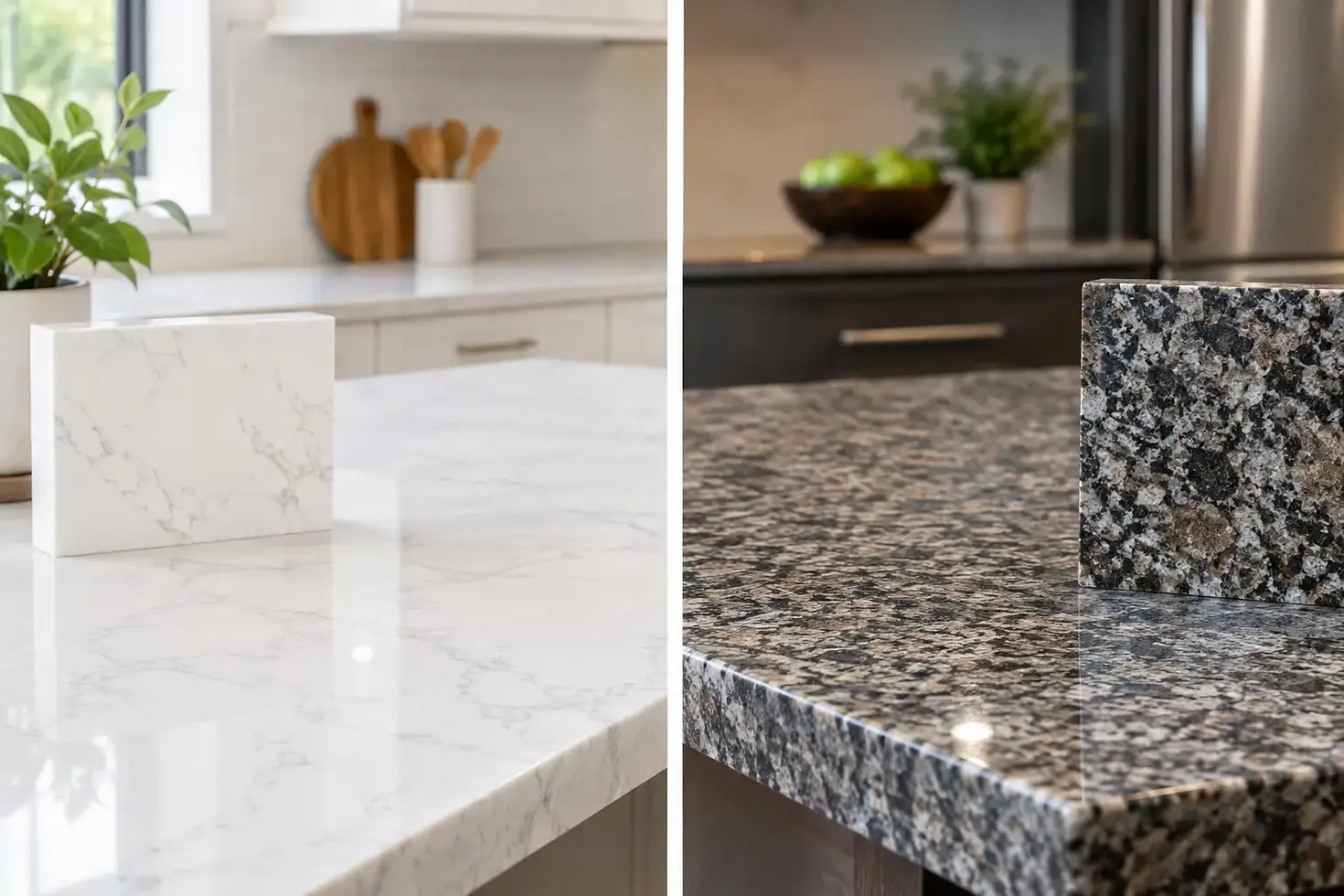
Quartz Versus Granite Countertops Compared

A countertop decision becomes very real when cabinet measurements are complete, appliance locations are set, and you are choosing a surface your household will use every day. In the quartz versus granite countertops decision, neither material is automatically better. The right choice depends on how you cook, how much maintenance you want, the look of your kitchen, and how the countertop fits the rest of the remodel.
For Bay Area homeowners, the practical details matter as much as the showroom sample. A well-installed countertop should sit properly on level cabinetry, work with the backsplash and sink, and hold up to daily use for years. Understanding the differences early helps avoid costly changes after fabrication has begun.
Quartz Versus Granite Countertops at a Glance
Quartz countertops are engineered slabs. They are made with natural quartz particles combined with resins, pigments, and other binding materials. This manufacturing process creates a consistent surface available in a wide range of colors and patterns, including options that resemble marble or natural stone.
Granite is a natural stone cut from quarried slabs. Each slab has its own mineral movement, veining, and color variation. That individuality is a major reason homeowners choose it, but it also means the slab you select matters more than a small showroom sample.
Both materials are substantial, durable choices for a kitchen remodel. Both require professional templating, fabrication, and installation. The differences show up in daily care, heat resistance, visual consistency, and how each surface responds to damage or staining.
Appearance: Uniform Design or Natural Variation
Quartz works especially well when a homeowner wants a controlled, predictable appearance. A large kitchen with a long island may benefit from the consistent color and pattern available in engineered slabs. Quartz can support clean contemporary kitchens, but it also comes in warmer designs that work with traditional cabinets, wood flooring, and painted millwork.
Granite brings natural variation that cannot be duplicated exactly. Some slabs have a quiet, uniform field; others have dramatic veins, crystals, and movement. This can make the countertop the visual center of the room. For homeowners who appreciate natural materials and one-of-a-kind finishes, granite often has more character.
There is no universal rule for resale value based on material alone. Buyers usually respond to a kitchen that feels cohesive, well maintained, and professionally finished. A thoughtfully selected quartz countertop can be just as appealing as granite, while an overly busy stone may not suit every buyer. Viewing full slabs before committing is a smart step, particularly with granite.
Durability in an Active Kitchen
Both quartz and granite are hard surfaces that hold up well under normal household use. They are resistant to scratching compared with many other countertop materials, but neither is indestructible. Avoid cutting directly on either surface. Knives can dull, and hard impact can damage an edge or corner.
Granite generally handles heat better than quartz because it is natural stone. A hot pan placed briefly on granite may not cause a problem, but using trivets remains the responsible approach. Sudden temperature changes can affect stone, and cookware can leave marks or cause damage depending on the circumstances.
Quartz is less forgiving with heat. The resins that bind the slab can discolor, scorch, or crack under high heat. Hot pots, baking sheets, slow cookers, and heat-producing countertop appliances should sit on protective pads rather than directly on quartz.
Granite can chip around a sink cutout, exposed corner, or overhang if it receives a hard hit. Quartz can also chip, especially at edges, and it may crack if cabinets are not properly supported or level. Proper installation is not a minor detail with either material. It is part of the countertop's long-term performance.
Cabinet Condition Matters
Countertops cannot correct weak or uneven cabinets. Before installation, cabinetry should be securely anchored, reasonably level, and able to carry the slab weight. Islands, bar overhangs, and large unsupported spans may require additional brackets or structural support.
During a kitchen renovation, this is the right time to address damaged cabinet boxes, out-of-level floors, plumbing locations, and electrical changes. Trying to work around these issues after a stone template is complete can affect the schedule and add expense.
Maintenance and Stain Resistance
Quartz has a clear advantage for homeowners who want low routine maintenance. Its nonporous surface does not usually require sealing. Everyday cleaning generally involves a soft cloth, warm water, and a mild cleaner recommended for the material. Avoid harsh abrasives, strong solvents, and cleaners that can leave residue or affect the finish.
Granite needs more attention, although it is not difficult to maintain when properly sealed. Most granite countertops should be sealed at installation and resealed as needed based on the specific stone, use level, and sealer product. A properly sealed surface helps resist absorption from cooking oil, wine, coffee, and other common kitchen spills.
Granite's maintenance requirement should not discourage homeowners who prefer it. Many families are comfortable with periodic sealing, especially when they value the look of a natural slab. The key is knowing what you are choosing and cleaning spills promptly rather than assuming any stone surface is maintenance-free.
Cost: Look Beyond the Slab Price
Installed cost can overlap significantly between quartz and granite. Pricing varies based on slab selection, thickness, edge profile, kitchen layout, cutouts, seam placement, demolition needs, and access to the home. A simple galley kitchen with standard edges will not price the same as a large island with a waterfall panel, multiple sink cutouts, and complicated seams.
Granite pricing can range widely because some slabs are more readily available while premium selections are rarer and more difficult to fabricate. Quartz also ranges from basic patterns to high-end designs with more realistic veining or specialty finishes.
When comparing estimates, make sure each scope addresses the same work. Confirm whether the price includes old countertop removal, hauling, plumbing disconnection and reconnection, backsplash work, sink installation, cooktop cutouts, and any required cabinet modifications. The lowest material number is not always the lowest complete project cost.
Fabrication and Installation Considerations
Once cabinets are installed and appliances are confirmed, the countertop fabricator creates a precise template. Changes after templating can lead to added cost or fabrication delays. This is why sink models, faucet locations, cooktop specifications, and backsplash decisions should be coordinated before measurements are taken.
Seams are normal with both quartz and granite, especially in larger kitchens or layouts that turn corners. A professional fabricator plans seam placement to make it as unobtrusive as possible while accounting for slab dimensions, transport, and structural strength. Natural granite patterns may make seams less noticeable in some locations, while a highly veined quartz design may require careful vein matching.
The sink is another important decision. Undermount sinks are common with both materials and create a clean transition from countertop to basin. Proper support, sealing, and plumbing connections are essential. A countertop installation is only finished when the surrounding trades are coordinated and the work area is protected.
Which Countertop Fits Your Home?
Choose quartz if you prefer consistent color, a broad selection of design options, and minimal sealing or stain-related maintenance. It is a practical choice for many busy households, provided everyone in the home uses trivets and avoids placing hot cookware directly on the surface.
Choose granite if you want a natural slab with distinctive movement, strong heat tolerance, and a surface that develops its own visual presence in the kitchen. It is well suited to homeowners who do not mind periodic sealing and want the variation that only natural stone provides.
A third factor is the kitchen itself. Cabinet color, lighting, backsplash tile, flooring, and the amount of natural light can all change how a slab looks once installed. Bring samples into the room when possible, and look at them in morning, afternoon, and artificial light. A countertop should support the entire kitchen rather than compete with every other finish.
For a remodel that involves cabinetry, electrical, plumbing, flooring, and countertop coordination, working with an experienced general contractor can keep the sequence organized from start to finish. Pro-Construction helps Bay Area property owners plan the connected details so the finished kitchen is built around daily use, not just a material sample.
The best countertop is the one that matches the way you live and is installed with care. Take time to see full slabs, confirm the complete scope of work, and choose a surface you will be comfortable using every day.



Comments